7 Best Manual Tile Cutters (for Ceramic, Porcelain, and Glass)
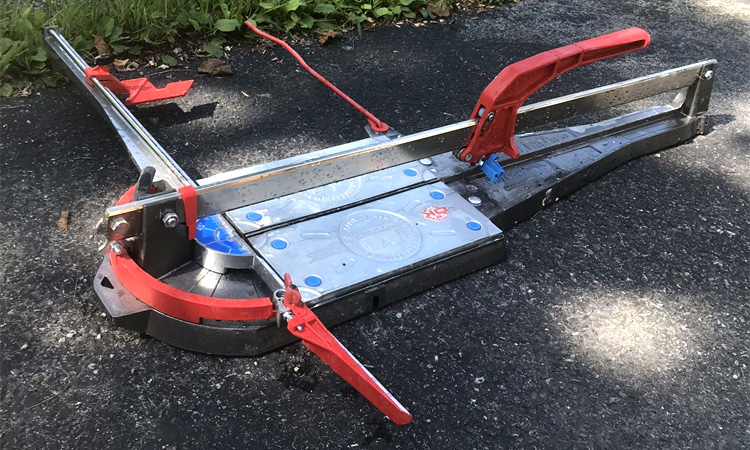
Laying tile can be a harrowing thing without the right tools. Not only are the tile materials fragile when loose, but they can be difficult to safely cut without cracking.
Thankfully, there are a wide range of tile cutters out on the market that make the job safe and easy. Below are some of the best manual tile cutters currently available.
Our 7 Favorite Manual Tile Cutters
| Product | Max Straight Cut | Max Diagonal Cut | Weight | |
|---|---|---|---|---|
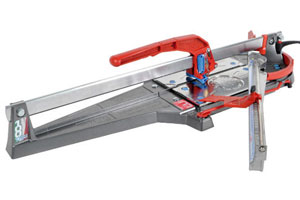 | Montolit Masterpiuma P3 | 29" | 21" | 9 lbs |
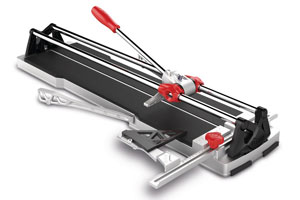 | Rubi Speed-N Tile | 28" | 20" | 10 lbs |
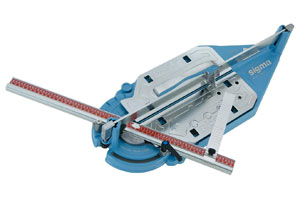 | Sigma 3B4 | 26" | 18.5" | 10 lbs |
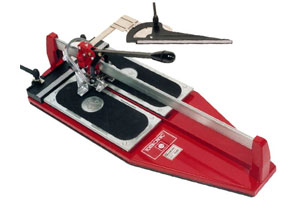 | Tomecanic Supercut 2175 | 29" | 20" | 31 lbs |
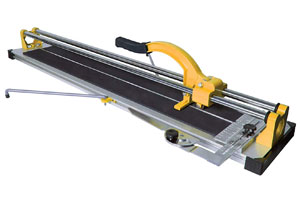 | QEP 10630Q | 24" | 16" | 16 lbs |
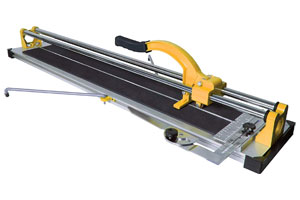 | QEP 10900Q | 35" | 24" | 23 lbs |
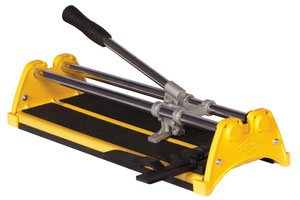 | QEP 10214Q | 14" | 10" | 6 lbs |
Manual Tile Cutter Reviews
#1 – Montolit Masterpiuma 75P3 29″ Manual Tile Cutter
This 29-inch tile cutter is designed to make manual cutting even easier. The push scribe handle is ergonomically designed to accommodate more extensive jobs and makes more powerful cuts than many competitor models, handling tiles up to 22mm thick.
Despite the size, this score and snap tile cutter doesn’t need to be disassembled for transport or storage. Its self-adjusting, patented scoring system saves on time and effort. Made of die-cast aluminum and nickel-plated steel, the tool is surprisingly lightweight without becoming fragile.
Add in a protractor square capable of setting accurate diagonal cuts and a titanium wheel designed to cut porcelain like butter, and it’s no wonder this is often considered the best manual tile cutter in the world. A smaller 24-inch version, the 63P3, is also available.
One of the most impressive compliments the Masterpiuma has received was a direct accuracy comparison to wet saws. The blade lasts a long time, and it’s both sturdy and rust-resistant.
The only downsides are that this is an Italian tool (and thus you’ll want to have a grasp of metric or use a conversion chart) and it’s more expensive. Of course, you definitely get what you pay for, so this is a tool worth investing in.
>> Check current price <<
#2 – Rubi SPEED-N 28″ Tile Cutter
This 28-inch tile cutter from Home Depot is great for ceramic, glass, and porcelain tiles. It can cut tiles up to 28 inches across and 20 inches diagonally with ease.
The 5/16 inch scoring wheel is augmented by a dual guide for better accuracy and a multipoint breaker for maximum breaking strength. Built of lightweight cast aluminum, the tile cutting board comes complete with side extensions to accommodate big tiles.
This is definitely one for the pros who are on a budget, with quality and versatility rolled into one durable package. Cuts tend to be high quality and the dual guide and other features make it easy to use on a variety of tasks.
Unfortunately, this isn’t a beginner’s tool by any means, as the wheel height needs to be accurately set and tested before starting a job.
It can be a little difficult to cut glass or small tiles. Also, note that this tool uses only metric measurements, so be ready to convert if you’re used to imperial.
>> Check current price <<
#3 – Sigma 3B4 26″ Manual Tile Cutter
Featuring a measuring bar capable of rotating 45 degrees in either direction, this 26-inch dry tile cutter is made of sturdy aluminum alloy and steel.
Unlike most manual cutters, this model’s 12mm scoring wheel can also handle some stone tiles up to 20mm thick. The 3B4 can cut tiles up to 26 inches wide or 18.5 inches diagonally.
While it takes a little practice, this can be an easy tool to use. It makes great cuts and many owners argue that Sigma’s quality is better than a Rubi. The spring-loaded base plates and rotating measuring bar only add to the convenience of the 3B4.
You may get an imported or US model, depending on the distributor. This can cause some confusion, since the US version uses imperial measurements on the bar, while the imported version is strictly metric. Be sure to check which version you’ll be sent in the event you want a specific measuring system.
>> Check current price <<
#4 – Tomecanic Supercut 2175 29″ Manual Tile Cutter
Capable of 29-inch long and 20-inch diagonal cuts, the 2175 can handle a wide range of tile sizes and materials.
A sturdy single rail guide and nine ball bearings in the cutter head help ensure a smooth and accurate scoring every time. The multipoint breaking system lever can apply an impressive 2500 pounds of pressure to split tiles with ease.
Owners have been impressed by the power of this tool, which can cut as deep as one inch. The cutting wheel slides smoothly every time, and there’s no denying the tool was built to last.
Alignment can be a little tricky at times due to the bolt positioning. It can also be tough to cut mosaic or perform angle cuts on small tiles.
>> Check current price <<
#5 – QEP 10630Q 24″ Manual Tile Cutter
Designed to work equally well on porcelain and ceramic tile, this 24-inch uses a 7/8-inch tungsten-carbide cutting wheel to make smooth cuts every time. Its aluminum alloy base is complemented by chrome-plated steel rails and linear ball bearing slides for better cuts on large tiles.
A high leverage bicycle grip handle further eases the cutting process. Thanks to the adjustable measurement guide, you can make accurate cuts in tiles up to 24 inches wide or 16 inches diagonally.
Owners have discovered the 10630Q can handle glass tile with little difficulty. It’s durable and the blade won’t need replaced for a long time. Support wings have also made it easier for users to make narrow cuts more efficiently.
Just about all of the issues related to this product come in the form of consumers receiving refurbished or otherwise used tools.
Some have noted broken or missing parts, while others found the guides were no longer straight, resulting in crooked cuts. Be sure to examine this tool upon delivery for any sign of prior use and purchase from a reputable retailer.
>> Check current price <<
#6 – QEP 10900Q 35″ Manual Tile Cutter
The biggest tile cutter on our list, this 35-inch monster is perfect for ceramic and porcelain tiles. As with the 10730Q, the 10900Q has dual chrome-plated rails and linear ball bearing slides.
A wide aluminum base and cutting table extensions allow you to make cuts as large as 35 inches wide or 24 inches diagonally.
Some owners have reported this tool can actually cut porcelain tile planks as wide as 36 inches. The ability to cut much longer lengths than the average model has made it a popular choice with many professionals.
As with other QEP models, the 10900Q is both durable and lightweight, making it an excellent choice for independent contractors on the go.
The large size has its drawbacks, as the middle spline may be too high for some projects and more pressure is required when used on larger tiles. As with most manual tile cutters, this model isn’t well-suited for textured tiles.
>> Check current price <<
#7 – QEP 10214Q 14″ Manual Tile Cutter
On the opposite end of the spectrum is this small tile cutter. Designed with the same quality and materials as its kin, the 10214Q is meant for smaller jobs and can handle tiles that the bigger models would have problems cutting. It’s probably the best tile cutter for DIYers with a couple projects lined up.
This little cutter has a rubber-coated aluminum alloy breaker bar which is gentle on tiles while still allowing a strong break. It can cut 1/2-inch thick tile up to 14 inches long or 10 inches diagonally.
It’s important to follow the directions on this model precisely, as it requires a good score for the breaker to do its job. Doing so, some users have been able to cut as little as one inch from the width of a tile.
Also, be sure to remove the support before attempting to snap, as it can serve as reinforcement for smaller tiles if left in place.
There have been very few problems with this cutter, although it’s possible to break the cutting bar by not following the included directions.
Also, keep in mind that this is a small tool for small tiles, so it will perform poorly on large or heavy tile. Use care to line up the metal portion of the breaker bar properly, as it can easily damage thin tiles otherwise.
>> Check current price <<
Tile Cutter Buying Guide
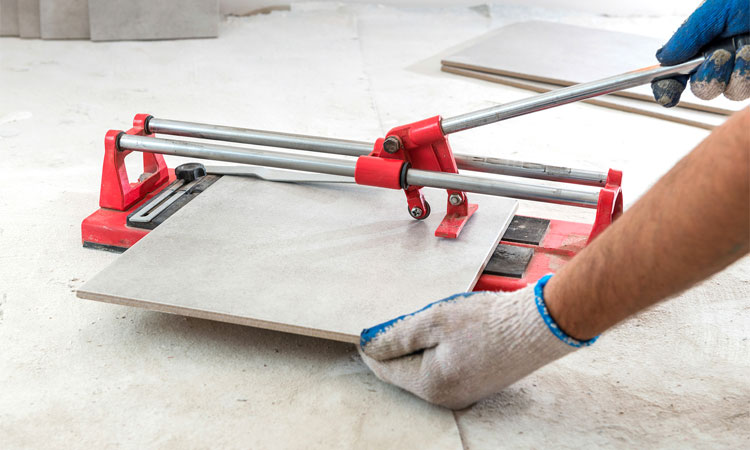
Owning a manual tile cutter is almost essential for laying tile along floors and walls. Unlike more traditional methods, there’s far less risk of a slip or shattering.
But there are a few things you should know when buying a manual cutter for the first time. The following are a few of the most common questions that will help you have a better experience.
Related: 12 Angle Grinder Uses for On-the-Job or Home Use
Manual Tile Cutter vs Electric – Which Should I Buy?
The answer to this falls under the infamous “it all depends” umbrella, but thankfully there are only a few factors to consider. Manual tile saws can wear you out on long jobs, but they’re easily portable and designed to be fast and accurate.
Conversely, electric tile cutters (AKA tile saws or wet saws) are designed for large-scale jobs and can handle tougher materials, such as stone tiles. They do the work for you and can cut more tile at once, but are difficult to transport and are designed more for industrial use than a simple home remodel.
See Also: Best Wet Tile Saws (for Ceramic, Porcelain, or Glass)
Anatomy of a Manual Tile Cutter
Tile cutters have a variety of important parts which you should take into consideration when choosing a model that’s right for you. Here are some of the most important parts and what they do:
- Cutting Base – This is the actual work surface. A good cutting base will have rubber feet and may also include folding wings to allow for larger tiles.
- Breaker Bar – This portion of the cutter assembly is designed to create pressure on one or more points along the score line, causing the tile to snap in two.
- Cutting Wheel – Made most often from tungsten carbide, the cutting wheel creates a deep groove in the tile, referred to as the score line.
- Guide Line – A mark or raised spline running along the middle of the cutting base to show where the cut will occur.
- Guide Rail(s) – One or two rail lines running the length of the tool, these help guide the scriber along a straight path.
- Handle – A good handle is essential for scoring and breaking the tile.
- Measuring Bar – Many models have an adjustable measuring bar that allows you to set the angle of a tile before cutting.
- Scriber – This is a fancy name for the cutter assembly (handle, breaker bar, and cutting wheel).
What Material Can a Manual Tile Cutter Cut?
Manual cutters are designed primarily to work with ceramic and porcelain tiles. Additional diamond-coated blades are available to permit your cutter to handle glass as well.
While it’s possible to use a manual model to cut some other materials (ex. vinyl), they’re not as efficient as a wet saw.
How to Use a Tile Cutter
You should always practice on some scrap tile before attempting to do a job if you haven’t had prior experience with tile cutters. However, once you’ve gotten good at the steps, it’s a quick and easy job.
- Using a pencil or other marking tool, mark out the cut line on the tile.
- Place the tile onto the cutter, glazed side up. The cut mark should line up with the raised guide line on the cutter’s base.
- Adjust the try square and ensure it’s fixed properly. You can cut more than one tile at once, but need to keep the square secured until you’ve finished all tiles.
- Place the scriber closest to you, lightly oiling if necessary.
- Applying even pressure, push the scriber away from you railing the guide rails in one stroke. Do not pull it back towards you.
- Align the breaker bar on the back of the scriber over the score line, if necessary. Usually, the bar is already lined up perfectly after you’ve scored.
- Press down firmly on the scriber handle to snap the tile in two.
- Gently sand the break line on the tile, if necessary, before laying.